Landscaping With Lava Rock the Way Island Yards Do
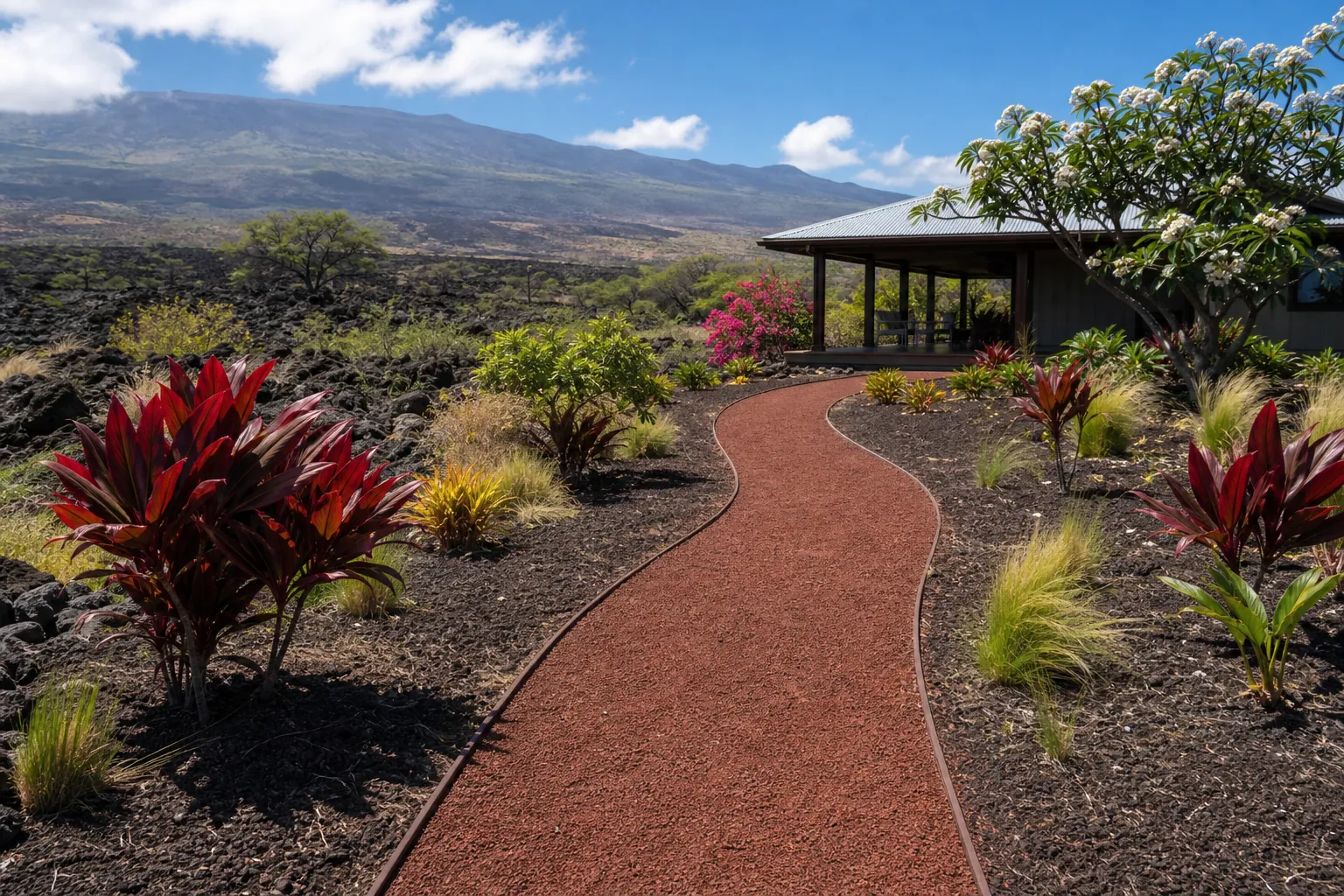
On the mainland, lava rock usually means a bag of light red stone from the garden center. In Hawaii it is the ground under the lawn, and the real question is which form of it goes where. Island yards work with porous cinder, dense crushed basalt, and larger stone for edges and walls. Put any of them in the wrong job and you end up doing the work twice.
What lava rock means in Hawaii
The state's own road specifications read like a list of lava products. Section 703 of the HDOT standard specifications calls for crushed basalt as the coarse aggregate in concrete, crushed and screened basalt for asphalt pavement, and "hard, tough, durable, lava rock" for filter material. Cinders are allowed in embankment fill.
For landscaping, those materials fall into two families that behave very differently. The USGS volcano glossary describes cinders as glassy fragments full of gas bubbles that were frozen in place when the magma blew apart in the air and cooled fast. Basalt, in the same glossary, is dark gray to black volcanic rock. Crushed, it is what island yards sell as blue rock.
That gives you the rule of thumb. Cinder is light and porous, and it crushes. Basalt is hard and keeps its shape under a load. The common mistake is asking cinder to do basalt's job.
Cinder for paths and bed cover
Cinder is what most people picture when they say lava rock in a Hawaii garden. The Cinder sold here is a 3/8 inch graded mix, listed under both red cinder and black cinder, and its product page puts it on garden paths, front and side yard walks, between stepping stones and around patio borders. Rain soaks through it instead of running off the top, which is the reason to pick it for a walk in the first place.
Build the path before you spread the cinder. The product page's own recipe for a foot path is 2 inches of cinder over a 2 inch compacted base, about 4 inches of digging in all. Woven landscape fabric goes under it, seams overlapped 6 inches and stapled every 2 feet, or the cinder works its way into the soil and the weeds come up through it. Make a one-person path 30 to 36 inches wide and the main route from the driveway to the front door at least 48. Set an edge first, because loose cinder walks into the lawn within a season.
Think twice before putting it on a driveway or in a wall. A Kona landscape supplier's guide to cinder recommends against both, because cinder is porous and easily crushed. Where a drive does get a cinder surface, it needs a compacted, draining course of crushed stone under it, not bare soil.
Crushed basalt for drainage and firm ground
Where water collects or something heavy sits, switch to basalt. 3/4 Blue Rock is roughly 3/4 inch angular crushed stone, also sold as 3/4 clean basalt. The rough faces lock together under compaction instead of rolling, and the gaps between pieces stay open for water. Its product page lists French drains, utility trench fill, retaining wall backfill, and the base under driveways, pads and footings.
In a landscape, that covers the hidden work. Blue rock goes in the trench that carries water away from a soggy corner, behind the face of a low wall, and under a pad for a water tank or a shed. The cinder or river rock you see on top is the finish.
Whether you compact it depends on the job: firm it down in thin layers under a pad, but leave it loose in a drain or behind a wall, where the open spaces are the whole point.
River rock, boulders and wall rock
Not every stone in an island yard is volcanic. The smooth 1 to 3 inch river rock on this site comes in tans, grays and browns with occasional reds, and large river rock runs 2 to 4 inches. Neither page says what rock it is, so treat both as rounded landscape stone rather than lava rock. They belong where water runs on the surface: a dry creek bed that carries storm runoff across the yard, the splash zone under a downspout, the edge of a pond.
Rounded stone rolls underfoot. The large river rock page says 2 to 4 inch stone is not for walking on and should edge a path, with cinder or crushed stone as the walking surface. For a dry creek bed it suggests 4 to 6 inches of depth, and for a border, one course set half above grade and half below so the stones stay put.
Neither product is wall rock or boulders. One Oahu quarry's price list carries "one man rock" and 3-foot-plus boulders as their own items, and those are the names to ask for when you are building a stacked wall or setting a feature boulder. Whatever stone forms the face of a wall, the drainage layer behind it can be 3/4 Blue Rock.
Leeward and windward choices
Rainfall changes the choice more than looks do. The Western Regional Climate Center's narrative on Hawaii's climate puts leeward coastal areas at 20 inches a year or less and the lower windward slopes of the big mountains at more than 300. In a great many places, it adds, annual rainfall climbs by more than 25 inches for every mile you travel, so the lot up the road can live in a different climate from yours.
On young lava, the ground can take water too fast to keep it. The same narrative describes drought-tolerant plants growing in places that get 100 inches of rain or more, because volcanic rock and soil let the water drop straight past the roots, and it says this is most common on the young Big Island. A cinder path does fine on ground like that, but planting beds need real soil under any cinder or stone cover. On hot, dry leeward lots, go easy on wide stone beds against a sunny wall: the river rock page itself warns that rock can hold and radiate heat, which may affect heat-sensitive plants.
On the wet side, water management comes first and appearance second. Give runoff a defined route, a dry creek bed lined with river rock or a trench filled with blue rock, before you dress the beds. The Kona coast of the Big Island runs backwards from the rest of the state: the climate center notes it is the only region where summer rain exceeds winter rain, and summer there brings frequent late-afternoon and early-evening showers.
Common questions
Is lava rock better than river rock?
They do different jobs. Cinder is light, porous and good for paths and bed cover, but it crushes easily. River rock is smooth and rounded, so it suits creek beds, splash areas and borders where water runs on the surface, and it rolls underfoot. For anything buried, loaded or meant to drain, use angular crushed basalt such as 3/4 Blue Rock.
How much upkeep does a cinder path need?
Not much, but some. The Cinder product page suggests raking the path level every month or two as foot traffic shifts it, pulling weeds along the border as they appear, and adding a light top-dress of about 1/2 inch every 2 to 3 years. Clear fallen leaves before they rot in place, because broken-down leaves turn into a seed bed for weeds.
How much cinder or rock should I order?
Measure the length and width in feet and decide the depth: 2 inches of cinder on a foot path, 4 to 6 inches in a dry creek bed. Multiply length by width by depth in feet and divide by 27 for cubic yards. The gravel calculator, which covers both cinder and river rock, turns that into tons.
Watch one rain first
Before you order anything, walk the lot during or right after a heavy rain and watch where the water goes. That walk tells you where the blue rock belongs, where a creek bed would earn its keep, and where cinder can simply be a path. The Hawaii delivery area page covers ordering by the ton or by the yard once you know.